


iPubers
Redesigning how an entire country distributes subsidized fertilizer — a presidential mandate that turned a Rp 200B billing problem into a 99.9% reduction in two years.
The one thing iPubers does
iPubers makes a farmer's subsidized-fertilizer purchase verifiable the moment it happens — replacing a slow, paper-based, error-prone process with a single digital transaction that the government can trust in real time.
Indonesia spends roughly Rp 54 trillion a year subsidizing fertilizer for its farmers. PT Pupuk Indonesia is the company tasked with delivering it through 516 warehouses, 1,067 distributors, and 27,136 kiosks. The problem wasn't delivering the fertilizer — it was proving every sale was correct, to the right farmer, within quota. That proof was being assembled by hand, on paper, weeks after the fact.
iPubers is the rebrand and evolution of Rekan, refocused entirely on that mission: subsidy redemption, done right, at the point of sale.
The counter-intuitive problem
Most people assume the hard part of a national subsidy program is logistics. It isn't. PT Pupuk Indonesia already delivered ~95% of its allocation every year for a decade.
The expensive failure was administrative. Because reporting was manual and the source data sat in disconnected systems, the government would later correct billings it couldn't verify — clawing back money for sales that may have been perfectly legitimate but couldn't be proven.
The number that made everyone stop: Rp 200 billion in subsidy-billing corrections in 2022 alone. Not lost fertilizer — lost trust, because the paperwork couldn't keep up.
I led the user-experience and interface design for the redemption flow, and built the end-user personas from field research with real kiosk operators. The two years I'd spent designing Rekan for low-literacy, low-signal users is precisely what this mandate demanded — because now every screen had legal and financial weight behind it.
How a redemption actually works
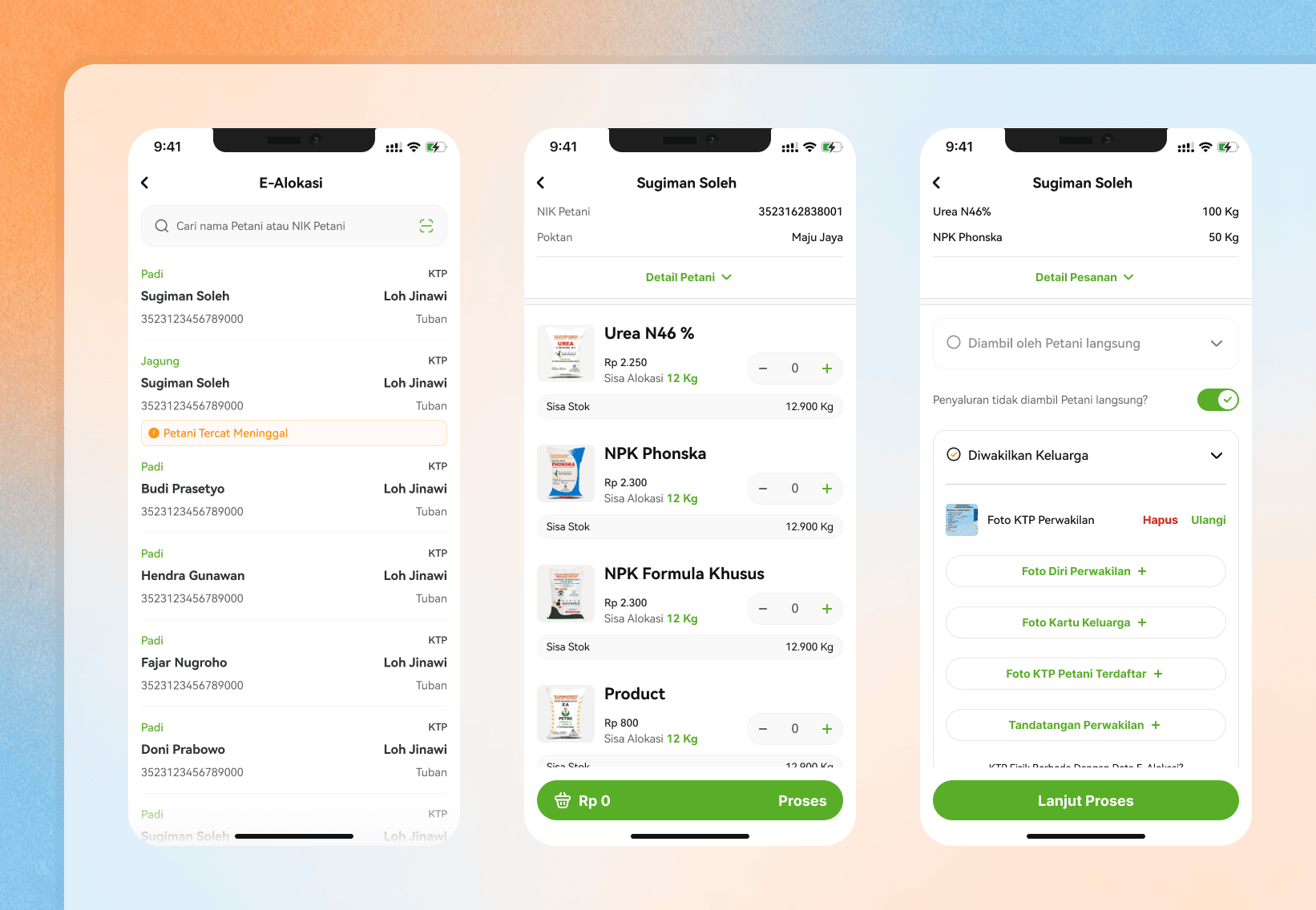
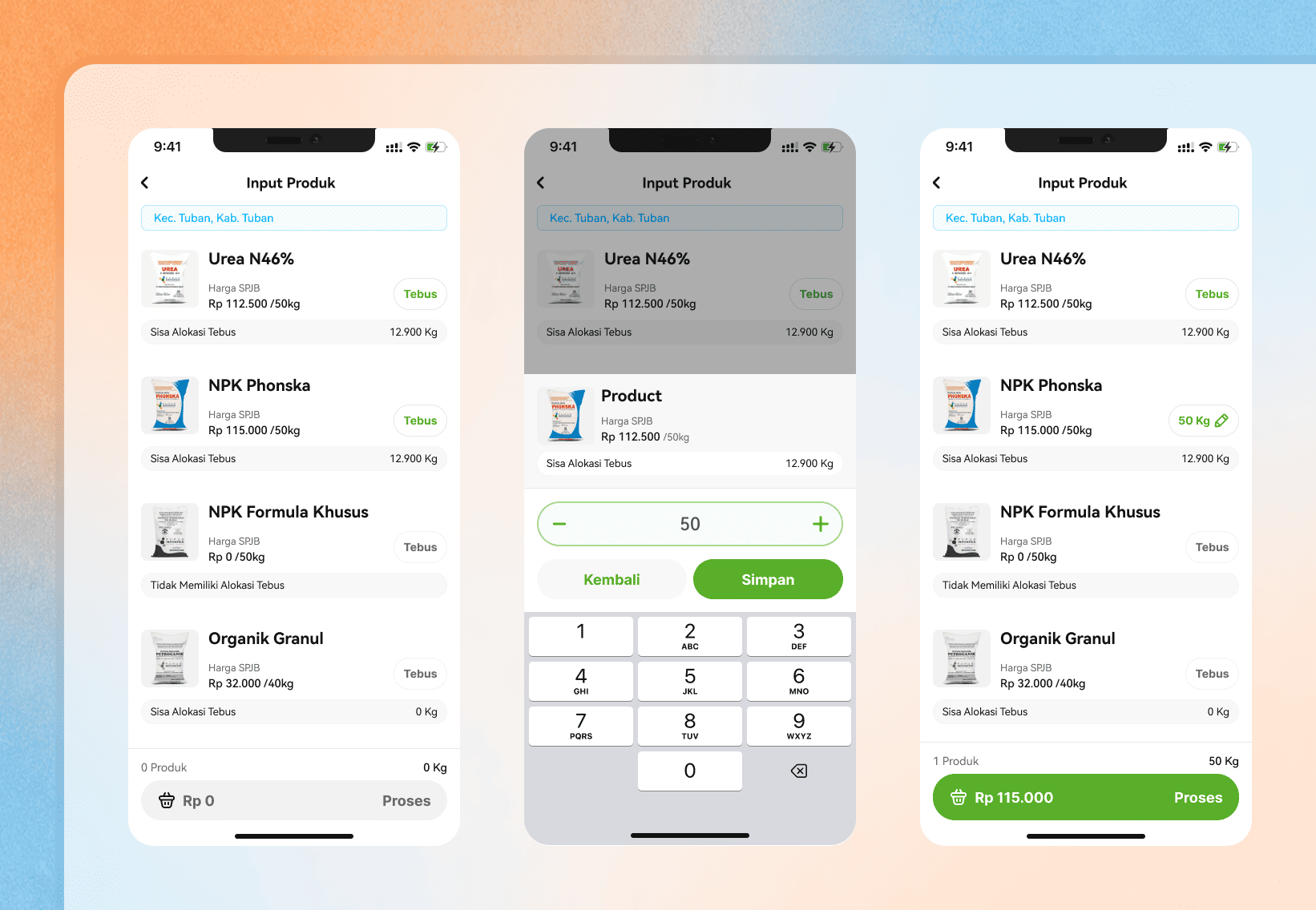
The entire design challenge was compressing a verification process into something a kiosk owner could finish in about two and a half minutes, even on a weak connection:
- Input the farmer's NIK (national ID number)
- Check stock against the kiosk's live inventory
- Check allocation against the farmer's quota in the Ministry's e-Alokasi system
- Capture the farmer's KTP — photographed in-app with geotagging, timestamp, and OCR / AI validation that catches a blurred or wrong card on the spot
- Redemption complete — stock and allocation update instantly; transaction data reaches the government at ~120ms latency
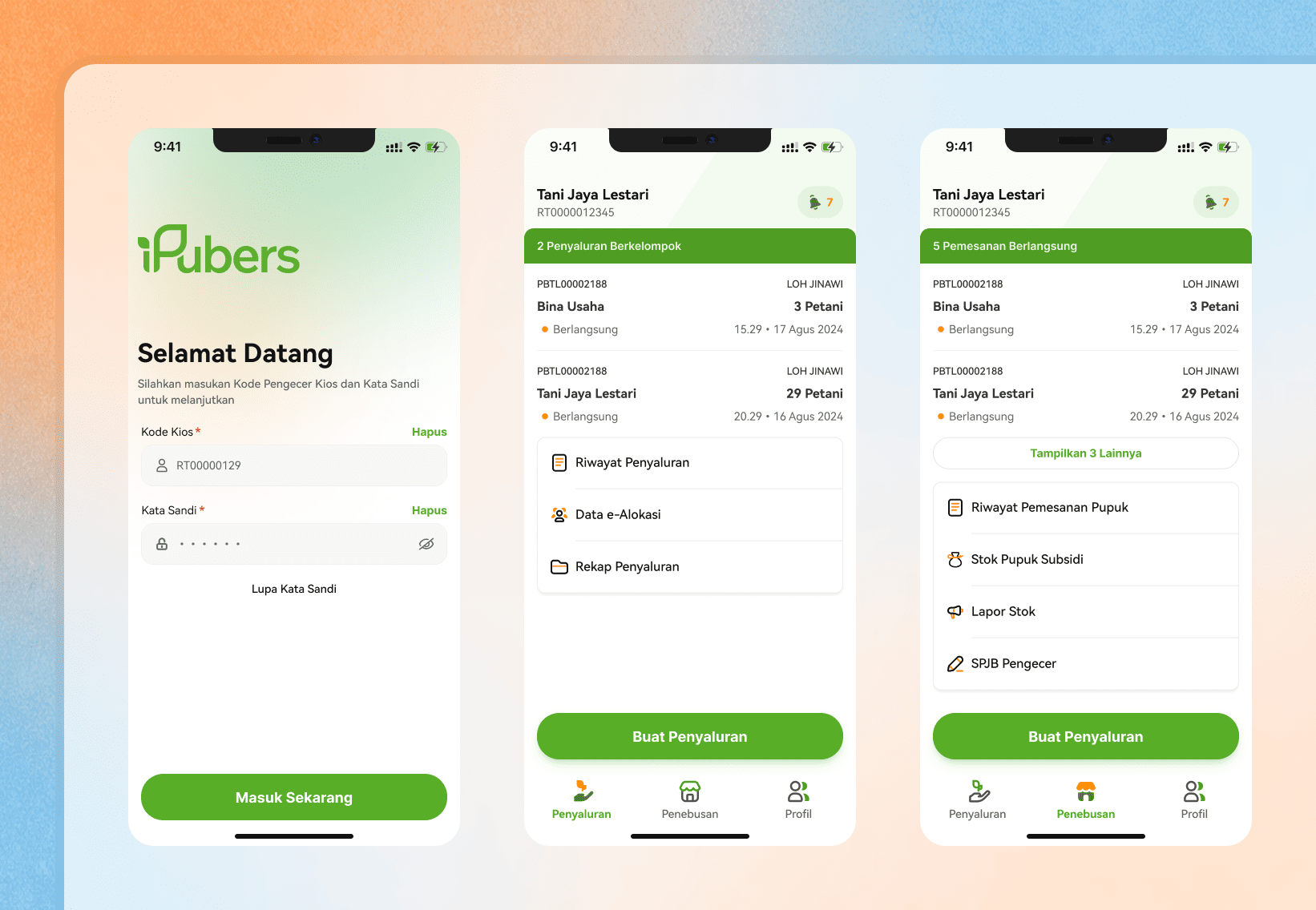
We designed for the messy real world: an offline mode for blank-spot kiosks, and a rule that lets the photo be taken at another point within the same sub-district when signal fails — so a connectivity problem never blocks a farmer from getting fertilizer.
The proof, in money and in audits
Subsidy-billing corrections collapsed:
| Year | Correction value | Reduction |
|---|---|---|
| 2022 (before) | ~Rp 200 billion | baseline |
| 2023 | ~Rp 15 billion | −91.6% |
| 2024 (through May) | ~Rp 9 million | −99.9% |
- Recovered ~Rp 181.9 billion in revenue that used to evaporate in unprovable corrections
- Administrative cost per kiosk fell from Rp 8.1M → Rp 4.3M per year (−46%), a national saving of ~Rp 102 billion/year
- Old SMS stock-monitoring system eliminated entirely (−100%, Rp 3.4B/year) — with better data quality
- Real-time stock visibility across all 27,066 kiosks — 100% coverage
Independent validation:
- A perception survey by the Coordinating Ministry for Economic Affairs (2023) rated the digital redemption experience at 95.8% — "Very Good", with ease-of-redemption scoring 100%
- The redemption standard was codified into national policy — the Director-General of Agricultural Infrastructure's technical guidelines (Kepdirjen PSP) — making iPubers the official method
Why it matters beyond the balance sheet
Strip away the billions and there are two people at the center of this.
There's the farmer, who needs the right fertilizer at the right moment in a planting season that doesn't wait — and who, in the old world, could be turned away by missing stock data or a paperwork mismatch he had nothing to do with.
There's the kiosk owner, who used to lose four extra working days at the end of every month assembling reports, carrying the quiet stress of "what if my notes are wrong and the correction lands on me?"
Designing iPubers was designing those two people some relief — and designing the public a system it could finally trust with Rp 54 trillion of its own money. Good governance, it turns out, is a user-experience problem.
The journey
iPubers is a creativity plot: how do you prove millions of subsidy transactions a month are correct, across thousands of islands, through users with low digital literacy and unreliable signal?
The breakthrough wasn't a single feature. It was the willingness to keep adjusting until the design met reality: three Juknis revisions, FGDs with the Coordinating Ministry and Ombudsman, offline fallbacks for blank spots, AI to catch a bad ID photo before it became a bad record. Each revision was a lesson in designing a system that has to be flexible enough to survive the field and rigid enough to satisfy an auditor at the same time.
The result is a product that started as a directive from the President and became the national standard for how subsidized fertilizer reaches Indonesian farmers — verifiable, real-time, and built to be opened by a 55-year-old shopkeeper in a village with one bar of signal.